 |
Systematic, step-by-step guidance for adult beginners and late-starters. Learn the Way of the Sword with 45+ years of traditional experience. |
- Home
- Level 2: Build Strong Kendo Basics
- Basic Kote Men Strike
Kote Men Strike:
Basic Kote Men Strike in Suburi
This is the basic kote-men strike. Kote-men is used in kendo all the time and is a very common technique in nidan-waza (two consecutive striking techniques).
I learned this strike as Kote Oyobi Men. Oyobi means "and" in Japanese.
When my sensei told me to do Kote Oyobi Men, I knew he meant the basic Kote Men strike. When my sensei said, "kote men," I knew I had to do a small and fast kote-men strike.
But you do not have to use Oyobi if it is too hard to say. You can say "big kote and men strike" for the basic kote men strike. And you can say "small kote men" for small and fast kote men strike.
Once you have learned Niho Zenshin Niho Kotai, this is fairly easy. All you have to do is to change the first strike from men to kote.
The difficult part, however, is combining two different strikes and doing them correctly. To do this correctly, we have to:
- bring our sword up to the appropriate height and
- do the right footwork without messing it up.
If you have acquired Niho Zenshin Niho Kotai Shomen Uchi properly, this should be easier to learn.
This is how to perform kote oyobi men uchi.
Kote Oyobi Men Uchi
- While raising your left hand above eye level so that you can see your opponent’s right kote, take a small step forward onto your right foot, just as you did for kyōdō kote. This step should be smaller than the step used when striking men.
- As you strike kote, snap up the left foot forwards. Make sure that the left foot does not pass the right foot or get too close to the right foot.
- Without going back to chūdan from the kote position, lift your sword above your head and take a big step forward onto your right foot.
- As you strike men, snap up the left foot forwards. Make sure that the left foot does not pass the right foot or get too close to the right foot.
- Now we are going backwards. While lifting our sword up as high as we can see the right kote of our opponent, take a step backwards onto the left foot.
- While striking kote, snap the right foot backward.
- Lift your sword above your head and take another step backwards onto the left foot.
- While striking men, snap the right foot backward.
Repeat steps 1 - 8 until you hear "Yame!".
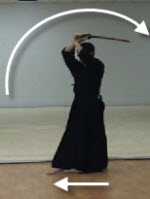 1. Sword up when stepping forwards
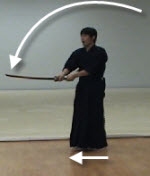 2. Strike Kote when left foot comes forwards
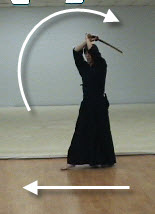 3. Sword up when stepping forwards
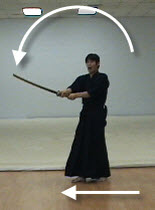 4. Strike Men when left foot comes forwards
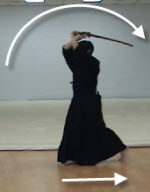 5. Sword up when stepping backwards
 6. Strike Kote when left foot comes forwards
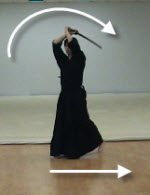 7. Sword up when stepping backwards
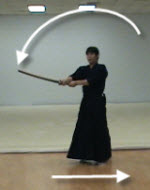 8. Strike Men when left foot comes forwards
COMMAND
- Kote Oyobi Men. Hajime!
- Ichi, Ni, San, Shi, Go, Roku, Shichi, Hachi, Kyu, Jyu
- Yame!
Repeat the count from 1 to 10 as many times as you want. Then give the command, “Yame!”
KIAI
1. On each count, the practitioners strike kote and men. So they shout, "Kote, men! "
So it is done as shown below.
Commander: Ichi
Practitioners: Kote, men! (going forwards)
Commander: Ni
Practitioners: Kote, men (going backwards)
Commander: San
Practitioners: Kote, men (going forwards)
.
.
Commander: Jyu (going backwards)
Practitioners: Kote, men
Commander: Ichi (going forwards)
Practitioners: Kote, men
and continue until
Commander: Yame!
Some Important Points
Make sure that you do not bring your hands above your head when you strike kote. That is not a big kote strike. Big kote strike is not as big as big men strike. Please refer to kote uchi for more information.
Footwork
I cannot say enough about this.
Keep your toes down while moving.
The left foot stays behind the right foot.
Some points you must pay attention:
- For kote strike, take a smaller step forward.
- Take a big step forward onto the right foot when striking men.
- When striking kote, make sure that you strike your opponent’s kote. People tend to strike a higher place than the actual kote height.
Back to Level 2: Build Strong Basics
Kendo Guide for Beginners—Available on Amazon
A Kendo instruction book written by a Japanese author for non-Japanese speakers who are enthusiastic about learning kendo.
All the basic instructions on this site are in this book, along with
- New and Better Photos (taken for this book!) and
- Newly Edited Contents
- Corresponding Videos
Kindle version is available too. Click here to learn more about the book.