 |
Systematic, step-by-step guidance for adult beginners and late-starters. Learn the Way of the Sword with 45+ years of traditional experience. |
Jogeburi Cuts:
First Suburi We Learn
Jogeburi (joge-buri) is a type of an empty cut (suburi) we learn in the early kendo training phase.
Joge means "up" and "down", and "buri" is a noun form of "to swing".
There are two types of joge-buri.
- The basic joge-buri
- Naname (Sayu) joge-buri
The purpose of joge-buri is to make sure that tachi-suji (the direction of the blade of your sword) is correct. (added in December 2015)
The basic joge-buri
First of all, we learn how to swing the sword without moving our feet.
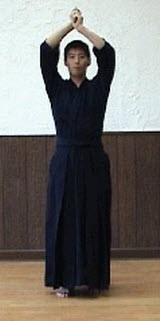
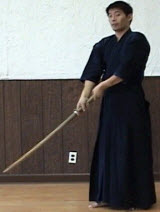
- From chudan, bring the hands right above your head.
- And simply bring your hands down and,
- Stop your sword when the end of the sword is about your knee height.
 |
 |
 |
<<POINTS>>
-- The Tip of the Sword is Too Low --
Do not go all the way down until the end of the sword comes really close to your buttocks when you bring your hands up.
When you do that, the pinkie and the ring finger of the left hand naturally becomes loose.
This is a bad habit to develop in the early stage and it is very hard to fix.
It is true that there is such a way of doing a suburi, but I recommend that the beginners should not learn that type because of the reason above.
It is very important to learn to grip a sword really tightly with the left pinkie and ring finger at this early stage.
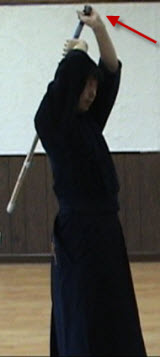 The kensaki is too low. The kensaki is too low. |
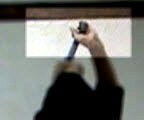 Since kensaki is too low, the left palm becomes loose. Since kensaki is too low, the left palm becomes loose. |
-- The Left Elbow Sticks Out---
When the tip of the sword is too low, the left elbow sticks out. So if you see yourself in the mirror and the left elbow is sticking out, it indicates that the tip of the sword is too low.
If the left elbow sticks out too much, you can see the inside of the left wrist. That means the tip of the sword is too far low.
This is bad not only because it gives us a bad habit but also it can hurt the left wrist. So we should avoid this.
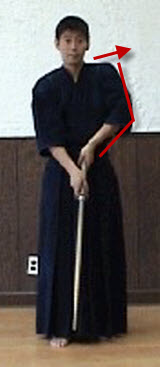 Bad example of Joge-buri with bokuto Bad example of Joge-buri with bokuto |
 Bad example of Joge-buri with shinai Bad example of Joge-buri with shinai |
Zenshin Kotai Joge-buri
Once acquired the joge-buri movement, try to do this with zenshin kotai okuri-ashi.
Going forwards
- When taking a step forwards onto the right foot, bring your sword up above your head.
- When bringing the left foot forwards, your sword comes down to the knee level.
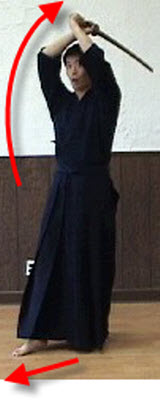 1 1 |
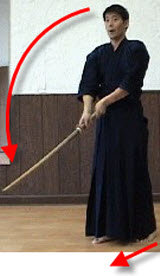 2 2 |
Going backwards
- When taking a step backwards onto the left foot, bring your sword up above your head.
- When bring the right foot backwards, your sword comes down to the knee level.
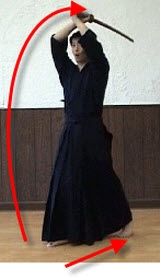 1 1 |
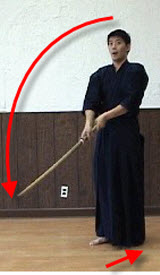 2 2 |
Naname Jogeburi
Naname means "diagonal" so in this joge-buri we swing our sword up and down diagonally.
This is also called sayu joge-buri or naname buri. You do not have to memorize all the different terms for this suburi but if you know them you don't get confused.
Basically the process is exactly the same as joge-buri but you are swinging your sword up and down diagonally instead of straight.
 Naname Joge-buri Strike Hidari Men of Your Opponent Naname Joge-buri Strike Hidari Men of Your Opponent |
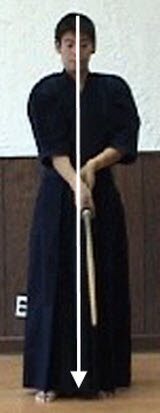 Naname Joge-buri Cutting Through (Left of Your Opponent) Naname Joge-buri Cutting Through (Left of Your Opponent) |
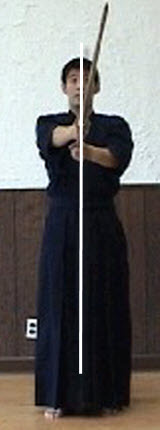 Naname Joge-buri Strike Migi Men of Your Opponent Naname Joge-buri Strike Migi Men of Your Opponent |
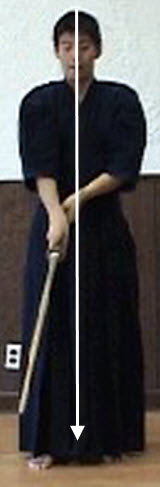 Naname Joge-buri Cutting Through (Right of Your Opponent) Naname Joge-buri Cutting Through (Right of Your Opponent) |
<<POINTS>>
-- Changing the directions of the sword --
We swing the sword up and down diagonally with sharp angles. See the picture below.
-- Your sword is straight above your head --
When you bring your sword up above your head, make sure that the sword is above your head as if you are doing the basic joge-buri.
When you cut down, swing your sword down diagonally.
-- Keep your left hand in the center --
It is common that beginners tend to move both hands off the center of their body because they TRY too hard to swing diagonally.
Your hands should not move off the center of your body. Especially your left hand should not move off the center too much.
Zenshin Kotai Naname Jogeburi
Once you acquire the naname joge-buri movement, try to do this with zenshin kotai okuri-ashi.
Going forwards
- When taking a step forwards onto the right foot, bring your sword up above your head.
- When bringing the left foot forwards, your sword comes down to the knee level.
Going backwards
- When taking a step backwards onto the left foot, bring your sword up above your head.
- When bring the right foot backwards, your sword comes down to the knee level.
Back to Level 2: Build Strong Basics
Kendo Guide for Beginners—Available on Amazon
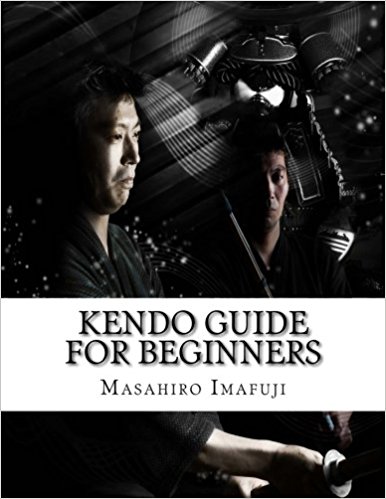
A Kendo instruction book written by a Japanese author for non-Japanese speakers who are enthusiastic about learning kendo.
All the basic instructions on this site are in this book, along with
- New and Better Photos (taken for this book!) and
- Newly Edited Contents
- Corresponding Videos
Kindle version is available too. Click here to learn more about the book.