 |
Systematic, step-by-step guidance for adult beginners and late-starters. Learn the Way of the Sword with 45+ years of traditional experience. |
Seme in Kendo Kata: Bridging the Gap
Paul Budden Sensei recently messaged me about the topic of Seme in Kendo Kata. Personally, I have often thought about how we can practise seme within the context of Kata.
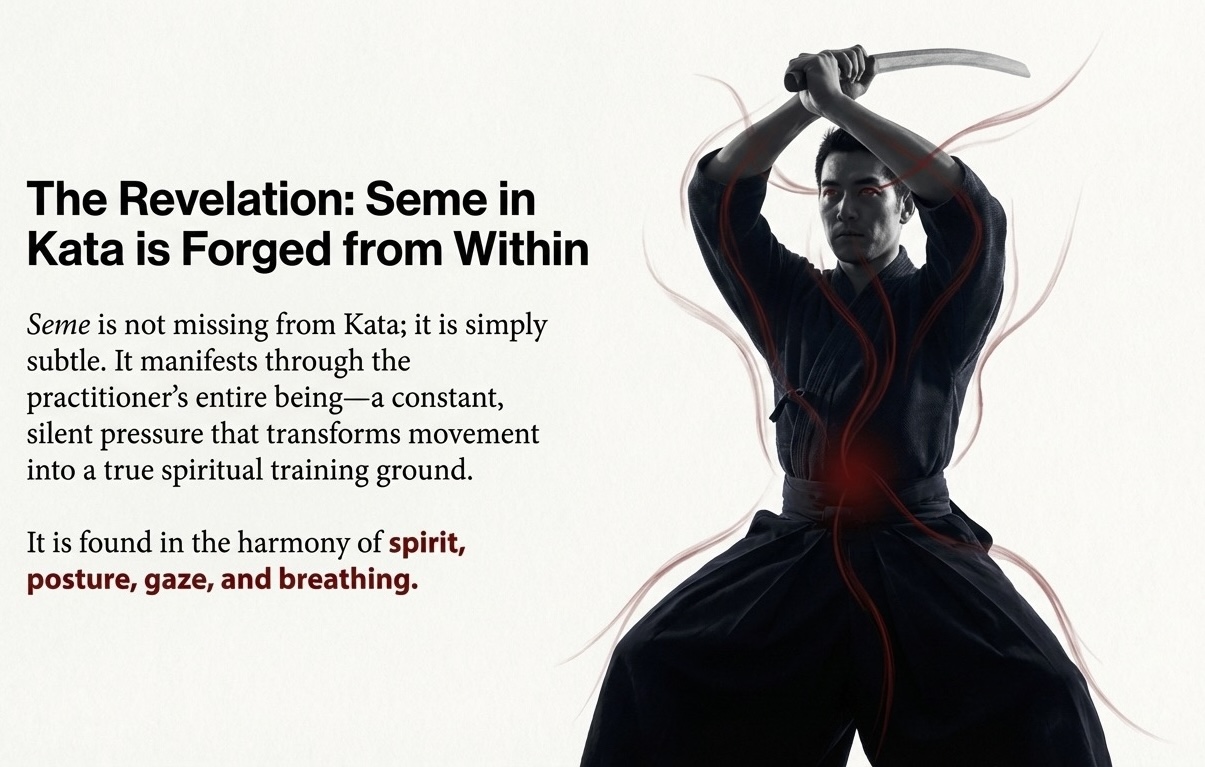 Seme in Kata is Subtle
On page 14 of the All Japan Kendo Federation (AJKF) Kata Instruction Book, there is a section titled “Explanation”. This text originates from the Dainippon Teikoku Kendo Kata manual; however, there is no official modern Japanese translation of it. Likely due to controversial concepts contained within the original explanation, the Federation has not translated this section into modern Japanese. I discuss this in detail in the Kendo Kata Study Guide.
Despite this, I would like to discuss a vital part of that explanation which is repeatedly mentioned: “Both Uchitachi and Shitachi proceed with the sen no kigurai.”
Understanding Kigurai and Sen
Kigurai (気位) can be translated as "noble bearing" or "pride in attitude" (referenced from Looking at a Far Mountain by Paul Budden). However, in this context, I believe it means that both Uchitachi and Shitachi must proceed with a strong sense of taking the initiative.
In my Kendo training, I was taught to maintain this sense of initiative as follows: “I am going to strike or thrust you if you do not come to get me. If you try to come and get me, I will finish you off with a counter-attack.” This is the true sense of sen (initiative) that I learned. Therefore, everyone who studies Kendo Kata must possess this mindset.
Finding the Opportunity
The Kata instruction book tells us that Uchitachi executes their techniques when they see an opportunity to strike in all seven tachi (long sword) Kata. As we know, the book does not explicitly list what these opportunities are, but they must exist. If you were Uchitachi, when would you strike Shitachi’s men?
If I were in Hidari-Jōdan (Left Jōdan), I would execute a men strike, attempting to cut the opponent in half, under the following circumstances:
- When I feel afraid of Shitachi coming forward (invisible pressure).
- When Shitachi's sen no kigurai becomes stronger than mine.
- When I can no longer withstand the pressure of tame from Shitachi.
- When Shitachi crosses over my uchi-ma line (physically occupying my space).
- When Shitachi is just about to execute his or her technique (debana men).
- When Shitachi's eyes move (a change in pupil size).
- When Shitachi's hands move.
Connecting Kata to Shinai Kendo
Since the manual does not explicitly state the opportunities for Uchitachi, we must discover them through our Kendo practice. This is why Kata and Shinai Kendo support each other. Kata helps us remove bad habits, but simultaneously, because the movements are pre-arranged, it helps us learn how to seize opportunities.
When we play the role of Uchitachi, we must actively seek such opportunities. Shitachi must create these opportunities. This dynamic provides an excellent moment to learn what seme truly is.
The Battle Begins Before the Strike
Paul Sensei also discusses Kamae. In Kendo, has your sensei ever told you that your fight starts the moment you stand nine steps apart from your opponent? This is something you must consider deeply.
Your battle begins as soon as you stand in front of your opponent. You should already possess the sense of sen right there. When you have the sword in the taitō position, you must take your opponent’s centre with the tsuka-gashira (end of the handle). When you draw your sword, you should already be dominating the centre. These small details are all part of your seme.
Furthermore, when you take your stance, you must do so in a way that your opponent sees no opportunity to strike you. That is why, when you intentionally “loosen” your kamae in Kata (or shinai kendo)f, your opponent perceives it as an opportunity to strike. (Paul Sensei’s book shares these opportunities on page 26).
Conclusion
When you practise Kata next time, please think about how you can express your seme and the reasoning behind your cuts. Consider why you are moving in the ways instructed. Doing so will make a huge difference in both your Kata and your Kendo.
As an Amazon Associate I earn from qualifying purchases.