You Got It!
Sotai Dosa:
Pair Work in Kendo
Sotai dosa is a pair work. Before you move on to this pair work, you should
have learned tandoku dosa thoroughly.
The Basic Routines
Rei: we didn't have to bow to our partners until now because we didn't have any partners.
This time we have a partner so we start from bowing to our partner. We have to have a certain distance between us and our partner.
It is said that we have to have nine steps between us and our partner.
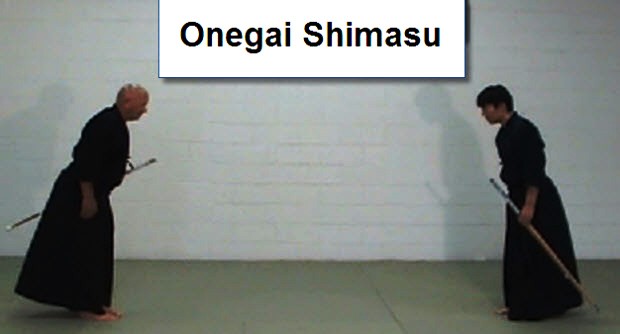
- Take a position at nine steps away from your partner and quietly stand in sageto position.
- Bow to your partner looking into your partner's eyes. Say Onegai Shimasu.
- Take taito position and start taking three big steps forwards onto the right foot.
- On the third step, draw your sword.
- Sit in sonkyo.
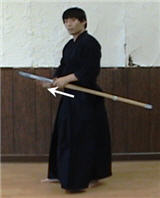
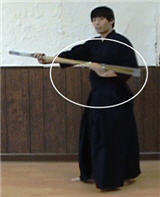
- Stand up and set yourself into the chudan position.
Sequence from 3. to 5. |
||||
 |
 |
 |
|
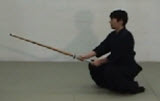 |
Chudan in Sotai Dosa |
||||
 |
||||
When you are done,
- Take chudan so your shinai and your partner's shinai meet at where you started.
- Sit in sonkyo.
- Put your shinai away into the taito position.
- Stand up and take five little steps backwards onto the left foot.
- Quietly lower your shinai into the sageto position.
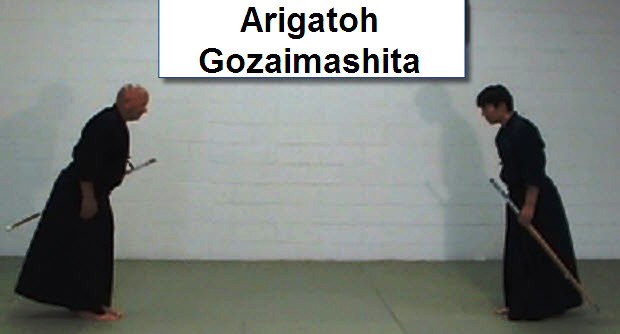
- Bow to your partner looking into your partner's eyes. Say Arigato Gozaimashita.
How to receive
If you are a receiver or motodachi, this is how you receive.
- Let go your left hand.
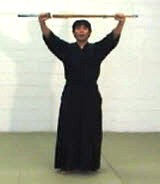
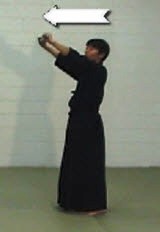
- Turn your shinai towards your body and have it horizontal as shown in picture.
- Grad your shinai between kensaki and nakayui.
- Position your shinai depending on where your partner is striking.
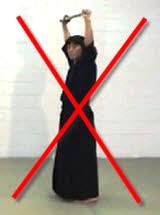
When you are receiving men strikes, make sure your shinai is in front of you, not above your head.
If your shinai is right above your head and your partner misses your shinai,
your partner may hit your face with his/her shinai.
| Not Right Above Your Head |
||||
 |
 |
 |
In the pair work, motodachi's job is more than just receiving.
It is motodachi's responsibility to adjust the distance between motodachi and his/her partner.
Therefore, after every strike, motodachi has to go back to chudan. And the striker or kakarite also has to take chudan.
This way they both know the right distance, i.e. issoku-itto-no-ma.
Some points that kakarite has to be aware of
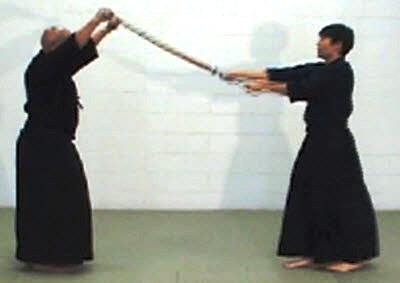
kakarite tends to aim at shinai instead of actual targets, because shinai is a closer target than the actual target.
For example, when kakarite is supposed to strike motodachi's men, kakarite's shinai is not reaching the motodachi's men because kakarite is aiming at shinai, not men.
This is very common and very understandable until kakarite gets used to the idea of actual striking.
However, as kakarite gets used to, he/she should take a bigger step forwards to strike men so he/she can really reach the actual target.
** Extra Warning!! **
Since kakarite has a target to strike, it is quite likely that kakarite puts extra strength/power into their strikes.That is completely opposite from what kakarite should do.
To avoid it, kakarite should concentrate more on taking a bigger step than striking. If you concentrate on striking, you are quite likely to get tense and lose your basics.
You have a target so you can actually feel how it feels like when you strike. This is the time for you to put everything you have learnt together. This is not an exercise to hit as hard as you can. Please remember that.
Kote Strike in Pair Work
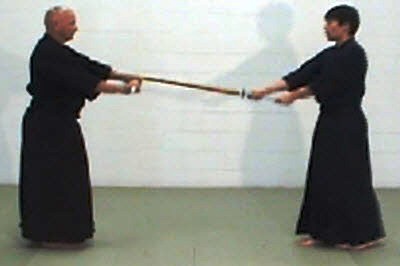
Kote strike in pair work is easier after you learned how to receive men strikes.
Basically motodachi just lowers their shinai from their men height to their kote height. This is how you receive kote.
- Let go your left hand.
- Turn your shinai towards your body and have it horizontal as shown in picture.
- Grad your shinai between kensaki and nakayui.
- Position your shinai depending on where your partner is striking.
Yes. The procedure is exactly same as the above-mentioned. You just have to lower your shinai at your kote height.
Again it is very important to go back to chudan after each strike.
kakarite has to take a smaller step forwards and lift up his/her shinai to the point where he/she can see their motodachi's kote. So he/she does not have to bring his/her hands right above his/her head. If you do not remember why, you can click here.
Do Strike in Pair Work
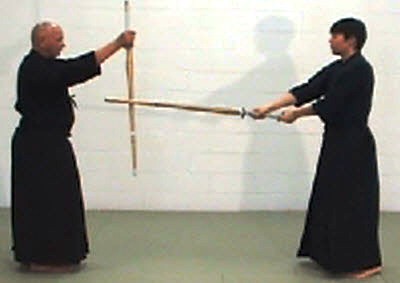
It is a bit difficult to receive do strikes if we are not wearing a body protection, do. If you are a motodachi, I suggest that you should wear your do to let your kakarite to strike your do.
However, I will introduce how to receive do strikes without wearing your do.
- Let go your right hand and lift your left hand up so the kensaki is pointing down.
- Grab the shinai with the right hand.
- The blade should be facing outwards.
- Place the shinai in front of you slightly to the right.
It is more difficult to do than just receiving kote and men. When you get used to this method, it should not be a big problem.
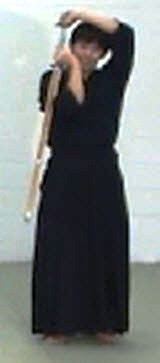
But you still have to go back to chudan every time kakarite finishes a do strike. It is a bit time consuming. There is another way to receive do strikes, but I do not recommend it.
| Not Recommended | ||
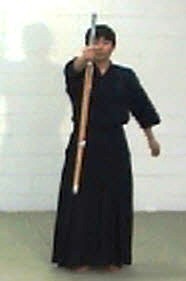 |
 |
It is much easier to receive do strikes with actual do protection. That is why I recommend wearing a do protection for this exercise.
Hope this helps.

About Hiro
Kendo is fun! Kendo is enjoyable! Adults beginners and late starters of kendo have hard time to understand that. If you are one of them, I want to help you with learning kendo and share the enjoyment and joy of kendo! Click here to know about me and Kendo-Guide.Com.
Search Your Topic
Newsletter
Would you like to subscribe to the Kendo-Guide.Com Newsletter to receive updates and exclusive videos only available for subscribers and patrons. Click here to find out more about the newsletter or click the orange button below to subscribe right now.
Privacy Policy | Disclaimer and Terms of Use | COMPENSATION AND AFFILIATION AFFIDAVIT | Contact.